Dr. Daniel Su, A Tempo Regeneration Center for Musicians WFU

Saturday, July 25, 2026

After the injury, how should we handle it and return to play following proper treatment?

Author: Dr. Daniel Chiung Jui Su


Case 1: A violinist based overseas had been struggling with a chronic shoulder and neck injury. One week before an international competition, the condition worsened to the point that the violinist could no longer raise the affected arm. After an unsatisfactory competition result, the musician immediately booked a flight back to Taiwan for treatment. 

Case 2: A conservatory viola student had taken a one-year leave of absence from school because of severe shoulder pain. Despite a full year of rest and treatment, the condition had not improved, prompting the student to visit our clinic. 

Case 3: A conservatory cello student had been involved in a serious traffic accident and could no longer play for more than ten minutes at a time. Despite undergoing numerous treatments, the condition failed to improve. The cellist was even told that returning to the instrument might never be possible before eventually coming to our clinic. 

At our specialized clinic for musicians, each patient underwent a comprehensive program that included diagnostic ultrasound, postural and biomechanical correction, and regenerative treatments targeting injured fascia, ligaments, tendons, muscles, and nerves. Surface electromyography training was also incorporated when appropriate. 

After one to three months, their pain and physical limitations had improved substantially. But reducing pain is only the beginning. The next question is: How can musicians safely return to peak performance and continue moving forward? 

This article is written by Dr. Su for every courageous musician who has completed treatment and is preparing to return to the stage—to step once again into the spotlight and feel its warmth. 

Let us now examine each part of it in detail. 


Posture 

After an injury, your posture needs to become even better than it was before in order to reduce the risk of reinjury. In many cases, an injury occurs because the musician’s previous posture and physical capacity can no longer meet the increasing demands of more challenging repertoire. 

The postural adjustments and rehabilitation exercises recommended during your clinic visits should therefore be practiced consistently. If you are uncertain whether your current posture or technique is appropriate, you may email Dr. Su every two months for further review and confirmation. 

Email: dr.daniel@gmail.com 

The Instrument 


How comfortable and responsive an instrument feels will naturally affect how easily it can be played. When returning to the instrument after an injury, it is especially important to remember that, at first, posture matters more than tone quality. Establish the correct posture first, and the sound will follow. 

For left-hand string pressing, begin by using the lightest possible pressure. It is acceptable if the string is not fully stopped at first. The priority is to maintain the correct hand shape, then gradually increase the amount of pressure as control improves. 

Every part of the instrument setup should be adjusted as carefully as possible. This includes the shoulder rest and chin rest for violin and viola, the endpin for cello, the instrument and chair height for double bass, support devices for wind instruments, bench height for pianists, and the placement of drums and percussion equipment. 

For string players, one simple way to help the fingers relearn a relaxed approach to stopping the strings is to use strings with lower tension. For cello, Larsen Magnacore Arioso strings may be a useful option for experiencing how little force is actually needed. Dr. Su has recently tried this set and found that its main characteristics are a softer response and a relatively warm, sweet tone. It may be suitable for smaller halls, chamber music, and even orchestral playing. Comparable lower-tension strings are also available for other string instruments. 

For the bow arm, it may be helpful to borrow several bows from friends or try different options at a violin shop. In general, a bow that is too stiff or too heavy can increase the risk of injury. No matter how beautiful the sound may be, it is not worth using a bow that places excessive strain on the body. 


Practice Strategy 

Do you remember which piece, musical passage, or type of practice first triggered your injury? Identifying these key problem areas is an important first step. You can then work through them one by one—but never force your way through the pain. 

Successful rehabilitation requires thoughtful, efficient practice. Use the least effort necessary, approach difficult passages intelligently, and progress gradually. 

After treatment, practice time should be increased according to a structured plan. 

The schedule shown below is based on a musician who had been unable to play for one year because of a persistent injury before coming to our clinic. After treatment, the musician used this schedule to gradually resume practicing. Each person’s timeline will be different, but the general principle remains the same: 

Increase the frequency of practice sessions before increasing the duration of each session. 

At the beginning, follow a “little and often” approach. It is better to divide practice into short sessions in the morning, afternoon, and evening than to complete one long practice session all at once. 

It is important to understand that Day 1 will be different for every musician. Some may begin as early as two days after treatment, while others may need to wait up to one month. The starting point also varies. For example, if a musician can already play comfortably for one hour, the progression may begin from that one-hour baseline. 

During follow-up visits, Dr. Su will provide individualized guidance based on each musician’s condition, recovery, and performance demands. 

Warm Up Before Playing—Do Not Stretch 

Before practicing, what the body needs is a proper warm-up, not static stretching. 

Stretching immediately before playing may temporarily reduce muscular responsiveness, speed, and performance capacity, thereby increasing the risk of injury. A dynamic warm-up is therefore more appropriate before practice or performance. 

Stretching is better performed after playing, when it can help relax muscles that have remained contracted or active during practice. 


Lifestyle, Nutrition, and Emotional Well-Being 

Developing healthy rest and sleep habits is one of the most important foundations of physical recovery. 

After regenerative treatment, injured tissues require sufficient nutrients to repair and rebuild. Adequate protein intake is therefore important, along with vitamins B and C, particularly during the first three months after the injection. 

Emotional well-being is also an essential part of recovery. Reading about mindfulness or meditation may help support both physical and psychological health. It may also be helpful to reflect on what this injury has taught you and how the experience can contribute to your growth as both a musician and a person. 

Fascia, Ligaments, Muscles, and Nerves 


After treatment, the fascia, ligaments, and muscles generally require approximately six weeks to reach a more stable stage of recovery. During this period, musicians should still avoid overly intensive practice, heavy lifting, and other activities that place excessive stress on the treated tissues. 

Post PRP care for musicians

Exercises to restore muscular balance can be gradually introduced after approximately six weeks. However, this does not mean conventional heavy resistance training. Instead, musicians should perform the specific exercises taught by Dr. Su during the clinic visit, tailored to the physical and biomechanical demands of their individual instrument. 

For patients who already have numbness or other symptoms related to nerve injury, recovery may take longer. In more severe cases, nerve healing often occurs gradually over several months. 

In the music of life, uncertainty is the only constant. 


Wednesday, April 22, 2026

Embouchure Problems in Wind Players: A New Approach to Diagnosis and Treatment

By Daniel Chiung Jui Su, MD, CIPS, RMSK

After presenting my diagnostic and treatment approach for embouchure problems in London PAMA conference in 2024, I received many questions from musicians and physicians overseas who wanted to learn more. This encouraged me to organize the method in greater detail, and I was honored that this work was later published in an international journal in early 2025. 

International Journal Publication:
Novel Ultrasound Examination and Guided Intervention of Peri-Oral Musculature and Fascia in Wind Players with Embouchure Problems: Technical Note


When a wind player develops an embouchure problem—especially when they could play normally before but can no longer do so—it is easy to assume that the issue is purely technical. In reality, embouchure dysfunction is often much more complex. Based on my clinical experience and research, there are four major factors to evaluate.

1. Breathing and air support

The first factor is breathing pattern and air support. When a musician does not use the diaphragm efficiently, the body may compensate by overusing the neck muscles, lip muscles, or by pressing the mouthpiece too hard. Poor posture can also increase tension in the fascia around the mouth, including the superficial musculoaponeurotic system (SMAS), which may contribute to overuse of the peri-oral muscles and fascia. 

To help the body feel abdominal and diaphragmatic support more clearly, I often ask musicians to practice while lying on a bed for a short period, then returning to an upright playing position. Due to offloading gravity, players can often benefit from this method and experience easier diaphragmatic movement. Light aerobic exercise, jogging, and avoiding smoking may also help improve cardiopulmonary endurance and support more efficient playing. 


2. Teeth alignment and jaw position

The second factor is dental alignment and jaw position. Problems such as malocclusion, a protruded jaw, temporomandibular joint dysfunction, or long-term changes in the inclination of the front teeth may force the mouthpiece or reed into an off-center position. This can create uneven pressure around the lips and increase the risk of injury.  

Today, clear aligner treatment (such as Invisalign) is much more practical for musicians than traditional braces in many situations. If needed, players should discuss timing and suitability with a qualified dentist and, ideally, in coordination with a physician familiar with musicians’ injuries.  

3. Instrument-related factors

The third factor is the instrument itself. Mouthpiece size and angle, as well as reed stiffness and shape, can all affect embouchure loading. Different instruments also generate different levels of intra-oral pressure. In reed instruments, a harder reed may place greater stress on the lips before it softens sufficiently during play.  

4. Injury of the peri-oral muscles and fascia

The fourth factor, in my view, is the most important—because it is also the factor that can often be examined and treated most directly. The muscles and fascia around the lips can now be evaluated in detail using high-resolution ultrasound. This makes it possible to identify structural injury, fascial imbalance, and functional deficits that were previously difficult to diagnose.  

In my study, the peri-oral structures discussed include the orbicularis oris, levator anguli oris, zygomaticus major and minor, buccinator, risorius, depressor anguli oris, modiolus, and the superficial fascia/SMAS. The paper also notes that wind players with embouchure problems may experience air leakage, tremor, poor endurance, difficulty in certain registers, poor articulation, and reduced tone control, which can be addressed with case-by-case, tailored treatment. 

This is why ultrasound matters. It allows us not only to understand the anatomy of the embouchure, but also to assess what happens under playing conditions and to guide treatment more precisely.  


Customized regenerative treatment for different instruments

Different instruments place different demands on the embouchure, and different injury patterns involve different muscles and fascial structures. For this reason, treatment should be individualized rather than standardized. In my practice, treatment may include customized ultrasound-guided regenerative intervention, including platelet-rich plasma (PRP), according to the player’s instrument, playing demands, and specific tissue injury. We also develop methods for using gel-form PRP to achieve maximal recovery in the shortest time for professional players. 


Protecting a wind player’s most valuable asset

For wind musicians, the embouchure is one of the most valuable and delicate functional systems in the body. It deserves careful evaluation, proper protection, and, when needed, precise treatment. My hope is that advances in ultrasound diagnosis and regenerative treatment will help more musicians around the world return to confident, efficient, and expressive performance.  

FAQ: 

What is an embouchure problem?
An embouchure problem is a playing difficulty related to the lips, peri-oral muscles, jaw, tongue, or surrounding fascia that affects airflow control, tone production, endurance, articulation, or range in wind players.  

Can ultrasound detect embouchure injuries?
Yes. In my research, I have developed a technique using high-resolution ultrasound to thoroughly examine peri-oral muscles and fascia, identify structural abnormalities, and guide treatment in selected wind players with embouchure dysfunction. 

Can PRP help embouchure injuries?
In Dr. Su's clinic, we have used PRP to treat more than 100 wind players with a success rate of more than 85%. Severe cases with severe air leakage or tremor-like motion, which encompass some kinds of embouchure dystonia, may need more treatment sessions. Most players received two PRP treatment sessions, which can be completed within a 2-week period. 


Saturday, May 11, 2024

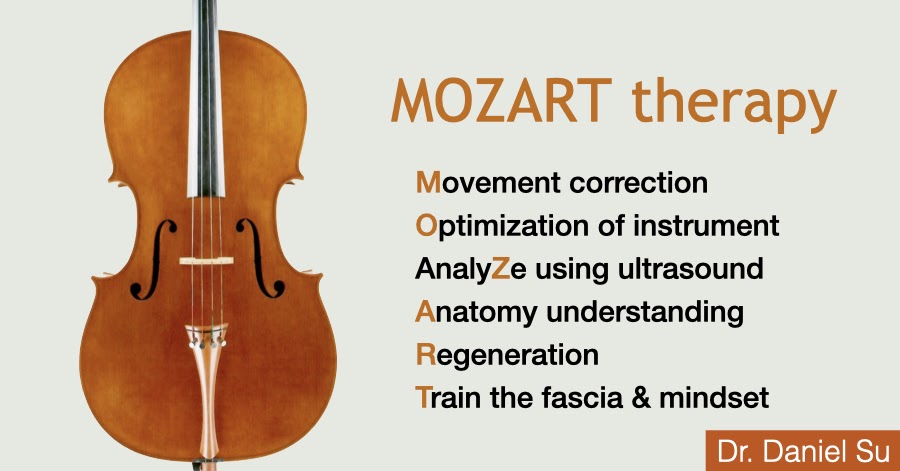
MOZART therapy

Author: Daniel Chiung Jui Su, MD, RMSK, CIPS 


In A Tempo Regeneration Center for Musicians, Dr. Su often encounters musicians complaining that they know their posture is not correct. Still, they cannot do anything about it, feeling like nothing they do is effective.  

Some students on their learning journey also find that everything goes wrong after adjusting their posture. They can't play as they like anymore and revert to their original posture. 

Sometimes, after practicing a certain piece, they suddenly realize that their posture has changed, whether it's their left or right hand. This change slowly becomes ingrained, eventually leading to injury. 

These are common problems I encountered, and through years of practicing, I gradually developed a set of treatments that I named the MOZART therapy.  

It was named MOZART therapy because I, Dr. Su, believe it's easy to remember for musicians. This makes it convenient for everyone to review which parts they need to strengthen. 


M is for movement correction 


M stands for Movement here, which refers to actions or, more broadly, static and dynamic postures. This is the most important aspect in MOZART therapy, as everything fundamentally stems from this M. If the Movement is not optimized, no matter how much effort is put in, the results will be less effective. 

However, just emphasizing Movement and attempting to change actions or postures directly can be quite challenging; often, it's not possible to succeed. That's why the following "O Z A R T" steps are needed to assist. 

O is for optimization of the instrument 


Optimization refers to optimizing the instrument being played and the surrounding setup (such as chairs and auxiliary equipment). Because everyone's body size and fascia structure vary in softness and hardness, optimizing the instrument to adapt to the body rather than the body adapting to the instrument is necessary. 

Z is for analyZing the movements  


In A Tempo Regenerative center for musicians, we use ultrasound to dynamically analyze the condition of the musculoskeletal system. We also use surface EMG to analyze the playing posture when necessary.  

Ultrasound examination is operator-dependent, especially when treating musicians. The quality of the ultrasound scanning and experience will majorly impact the diagnosis. This is also the most challenging aspect of diagnosis among musicians because each instrument, even with the same painful point, requires examining different areas and structures. Therefore, having a check-up in one area doesn't guarantee no issues elsewhere. 

A is for knowing your Anatomy better.  


Playing music is an art that involves Energy, space, and time, just like the body does. The more we understand how to use our bodies properly and gain correct knowledge, the more we can reduce the chances of making mistakes. 

When should stretching be done? Can I work out? Can I get a massage? Why is stretching effective sometimes but not others? All these questions boil down to anatomical and physiological concepts in medicine. 

Warming up is necessary before playing, so dynamic activities should take precedence. Stretching should be done after practicing the instrument. But is your stretching correct? Can every muscle be stretched? This requires a more professional assessment. 

Can you work out? It depends on which part of your body you want to work out. Not everyone is suitable for working out, and not everyone's current condition is suitable; assessment is needed. Furthermore, working out should mainly focus on the back muscles, and it's best to avoid gripping equipment with your hands. The nuances behind these recommendations vary based on the assessment and the instrument being played. 

Massage helps relax tight muscles and restore them to their original length. However, due to poor posture, many muscles are often held in elongated positions while playing an instrument. Massage cannot resolve this kind of soreness and may even worsen it. For musicians, this affects the ease and precision of playing. 

Understanding the different anatomical structures associated with each instrument is crucial. These are typically discussed and addressed individually in lectures and our outpatient settings.  

In short, the answer to these questions is NOT a simple yes or no. It depends on your condition.

R is for the regeneration of the injured tissues using PRP  


During musicians’ lengthy practice sessions, different playing postures for the same instrument can lead to different injury locations. Here, "locations" don't simply refer to broad diagnoses like shoulder pain or tendon inflammation but rather to the precise muscles, nerves, and fascia areas that are affected. 

The treatment precision needed for musicians is measured in millimeters. 

When we can target areas with a precision of less than 1-5 mm and identify them accurately, that's the level of treatment precision musicians require. Precision is as crucial as it is in our approach to music. 

For musicians' regenerative therapy, which uses glucose solution and platelet-rich plasma (PRP) for regeneration, the goal is not only for pain relief by healing the injured tissues but also for rebalancing the body posture in a better position for best performance. This includes playing instruments with more ease and adjusting postures to meet demands better, and as a result, the injection sites are entirely different from those for the general population. 

T is for training the right muscles and mindsets.  


In a tug-of-war competition, if only the people at the front (labeled as A in the diagram) exert force while those at the back (labeled as C) are not, the front individuals will likely get injured over time. Treating the injured person doesn't help in returning to tug-of-war (or playing the instrument) because the key lies in those at the back who are not exerting force. 

Therefore, it's essential to identify and adjust the muscles that are not exerting force or are overexerting in each performer to avoid injuries after picking up the instrument. This adjustment is an ongoing process as long as you're playing, requiring self-assessment, especially when learning new pieces or using challenging techniques. 


Training the right mindset is also crucial. The pursuit of musical perfection is a lifelong endeavor. 

From childhood to adulthood, from music classes to music school to graduation, experiencing countless performances, competitions, auditions, solo concerts, and more, thoughts of winning and losing inevitably occupy a corner of our minds. 

We must constantly remind ourselves of our true intention when facing music. In doing so, we can pursue excellence without excessive attachment to success or failure, ultimately achieving a healthier mindset for practicing and performing. 

The pursuit is a growth mindset, focusing on making small improvements every day and progressing slightly in each musical event compared to the previous one, which is something we can control relative to the idea of musical perfection. 

Focus on the process, not just the results. 

Don't let one concert or performance determine everything; instead, emphasize the development of your musical career. By honestly sharing your efforts and comparing yourself to your past self, you can reduce anxiety and stage fright. 

Approaching the pursuit of perfect music with a healthy mindset is crucial because there's no such thing as a perfect performance or perfect music in this world. 

Using MOZART therapy, let's move toward a healthier musical career and community. 

Poco a poco...

All rights reserved. 
The article was written by Dr. Daniel Su from A Tempo Regeneration Center for Musicians at Chi-Mei Medical Center, Department of Physical Medicine and Rehabilitation, Tainan, Taiwan. 

Musicians' playing posture. What are the factors in play?


Author: Daniel Chiung Jui Su, MD, RMSK, CIPS

In my clinic, musicians sometimes come in for suggestions on their playing posture. They may want better sound projection, tone quality, or better playability, or simply because feeling discomfort with their original playing posture.

Several factors should be considered when adjusting our playing posture in the classroom or clinic.

1. Instrument itself


How would everyone feel if you walked into a department store today to buy clothes and shoes, but everything was available in only one size? Unfortunately, most professional musicians face this when playing musical instruments.

Most instruments come in 'One size only.’ However, everyone's height, palm size, finger length, finger span, neck length, and shoulder width are different, making it challenging to fit into an instrument.

Let alone instruments like the piano, for which you don’t have any choice of the size of the keyboard….The keyboard of a piano won't shrink because of you! The finger span needed for Rachmaninoff and Chopin is just that large. Shostakovich's intensity must be strong, no matter your physical condition.

Besides the size, the playability of the instrument is crucial!

String players should find a luthier or instrument maker to adjust their instruments. While every instrument may seem the same, too many small details can impact each player's posture, tone quality, and potential muscular-skeletal injuries.


Taiwan's humid climate can cause the fingerboard to sink and the bridge to tilt, affecting string pressing. Conversely, other countries with dry climates may exert extra tension on wood instruments.

When buying a new bow, special attention should also be paid as it can affect the tendons and muscles around the thumbs, pinkies, and wrist joints. This is especially true if the new bow's center of gravity is different from the previous one or if the bow's bite depth or rebound force is stronger, all of which can potentially impact the neck and shoulders.


2. Individual’s physical quality


The arm length, hand size, finger length, and muscular amount of the body are only parts of the parameters when determining the body composition of the musicians. One of the key factors in the present studies, and also the common story in my clinic, is the laxity degree of the ligaments and fascia, which is partly genetic unless it’s an accumulated injury during the practice. Some musicians have stronger ligaments, and some have weaker (more laxity) ones. The ones with more laxity can spread the fingers more open than the others. Still, it also makes it easier to sprain and tear the ligaments, leading to tenderness and impacting the performance outcome.


In addition to the previous two factors, the constant pressure we face in music may also influence and deteriorate our playing posture.

In Taiwan's music competitions for school-age players (and this phenomenon happens in many other countries as well), the repertoire of the free piece is often out of the league for the players. It's not that it can't be done, but our muscles and tendons need time and special practice to adapt to that level of intensity.

I often see various compensatory postures in my clinic due to improper preparation for a sudden increase in intensity or demanding techniques. These postures can become habits and cause injuries that are hard to mend, affecting one's musical career in the long run.

Furthermore, composers usually dedicate their work to the most outstanding contemporary performers, who are among the best in their generation technically, musically, and physically, which puts extra stress if you are a musician in the “norm.”

It’s easier to say than do. In the clinic, musicians often come, even if they are professors in the conservatory or senior players in the professional orchestra, telling me that they know the correct posture and teach their students well, but they don’t know why it’s hard for them to correct their posture. Is it age or muscle memory or what?

We will discuss this question and the solution in the next paragraph.

No pain is pain.

All rights reserved. 

The article was written by Dr. Daniel Su from A Tempo Regeneration Center for Musicians at Chi-Mei Medical Center, Department of Physical Medicine and Rehabilitation, Tainan, Taiwan.